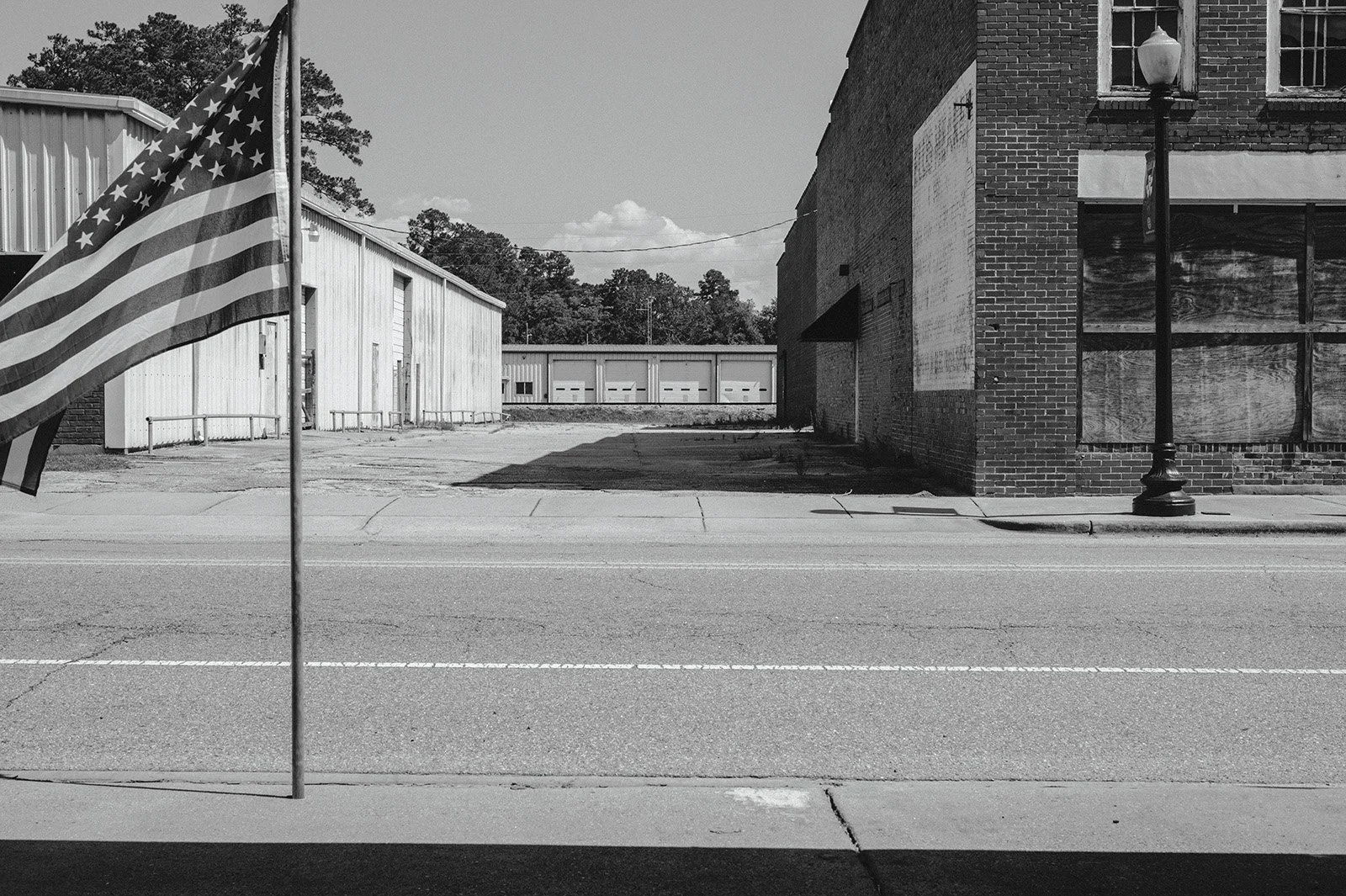
I parked half a mile down, on the street, since my father’s driveway only had room for one car. There was no front yard. The house was kitty-corner to a gas station and across the street from an insurance agency. I saw Hannah taking this in as we stood on the front step and I knocked, sweat gathering behind my knees. The window shades were down, which seemed both off and unwelcoming.
My father opened the door. He was unshaven, a roughness to his cheeks. He ran a hand along his head, which he kept shorn: an all-over grizzle. He was thinner than when I’d left for graduate school. He looked dazed, as if sunlight were foreign to him—or I was—which made me want to hug him. “Hello,” he said. “I thought we could go to The Cottonwood.”
“Dad,” I said. “I want to introduce you to Hannah.”
He put out his hand to Hannah, who shook it while saying how wonderful it was to meet him.
As we walked, Hannah asked my father how long he’d lived in Mountain Sound. Over thirty years, he told her. A red pickup rattled past. She said I’d mentioned that he worked for a farm equipment manufacturing company, and he nodded.
“He’s an engineer,” I said. “He works on designing the equipment and on helping with repairs.”
My father suggesting The Cottonwood, its windowfront advertising Budweiser and Bud Light, held mild promise. When I’d been a kid, he’d taken me here Friday evenings. We’d get cheeseburgers and a beer for him, a Coke for me. We’d still eaten mainly in silence, but I understood the outing as generous. He’d been trying to let the ambience—the chatter of other families celebrating the week’s end; men in the backroom playing pool and keeping up cheerful, not too profane invective—be its own festivity. My father had been prioritizing my needs over his own, as he’d always been uncomfortable among others.
The restaurant had cheap carpet the color of moss and tables that would’ve looked at home in a cafeteria. Hannah suggested a window looking out onto Main Street, but my father said, “I’d like to sit in the back.” He wanted our Friday table, closer to the pool tables, alongside the wall. The table only seated two but I grabbed a third chair and let it jut out into the aisle. A couple glanced our way, trying to decide if they knew us. The man, in a baseball cap and jeans, who looked too old for us to have overlapped in school, gave me a nod, which I returned. I passed muster, if barely. They studied Hannah a little longer than was gracious, although their stares held nothing lascivious or judgmental. Just an awareness that she wasn’t from here. I wondered what my father made of her, if he was sifting through what, these last few years, I’d written about her in my monthly letters (a law student, ferociously smart; funny, direct, lovely; a woman with a beautiful laugh; my favorite library companion; someone who’d introduced me to sushi, to swimming in the ocean; who liked to drive to the towns surrounding Ithaca on tiny weekend adventures; who didn’t mind my constant chatter about books, who loved to talk through her observations and ideas) with the dark-haired young woman before him, in jeans and an “Ithaca Is Gorges” T-shirt, summoning all her (formidable) skills in small talk to combat his silences.
A waitress came over, and I ordered my cheeseburger and fries, was again eleven years old, shy and inward and hopeful, if frightened by nearly everything. My father and Hannah said they’d have the same. “Jeremiah,” the waitress said. “Is that right? You were a senior when I was a freshman. Did you move back? Or just visiting? What’ve you been up to?”
She had freckles, hazel eyes. I had this quick memory of her near her locker with several other laughing girls. “Carla,” I said. “Just visiting. This is Hannah, my fiancée. We’re in grad school in upstate New York. And this is my father, Aaron Brenneman.”
She put her hand out to my father, saying it was good to meet him, and my father shook her hand, semi-smiling, the lines around his eyes spreading as if he were wincing. She didn’t recognize him. I supposed he wouldn’t come on his own. The last time we’d had dinner here had been the summer after I’d graduated from college.
“Jeremiah is a catch,” Carla told Hannah. “Quiet but thoughtful. I had my eye on him when we were kids.”
“He is a catch,” Hannah said.
The stupidity of my blushing. I couldn’t imagine what my dad thought hearing this.
“I want to go to school,” Carla said to me. “MSU is pretty close. Where did you go?”
“U of M.”
“Go Gophers.” Carla took our menus. “And now you’re in more school?”
“I plan to teach,” I said.
“You should teach here. Our high school could use a boost. It’s good seeing you—and nice to meet you too,” she said to Hannah and my father.
Hannah started telling my father how she’d grown up in Boston and gone to college in New York. She was now in her third year of law school. She recounted how we’d met at a party where, it seemed, everyone had studied chemistry but us. And she explained that we were going to get married in Boston next summer, but that otherwise our futures held some uncertainty since we were waiting to see what would come of my being on the academic market. We had to be prepared to go where the job was, and that, in turn, would determine where she took the bar exam.
“So you wouldn’t teach here,” my father said. “You wouldn’t consider it. As the waitress said.”
“I’m going to teach college, not high school. She misunderstood because I didn’t explain it fully.”
But, I was thinking, I had explained my career track to my father—clearly, sustainedly, in the letters I’d been writing since I’d arrived in Ithaca. I’d told him a tremendous amount about where I lived, what I was studying, reading, what it was like to teach undergraduates, what articles I was publishing and where. I was always careful to contextualize what I was describing, knowing it would be foreign to him. I’d been imagining the letters helped us both: I could formulate my thoughts without being affronted by his lack of response. He could take in the details of my new life at his own pace. In the moment, it might be too much to imagine his son in a seminar taught by a professor famous for his ideas about structuralism. But then he could mull over what I was describing and maybe come around to some of it. He might even, heaven forbid, be proud of me.